
Cloud Explorer
An AI-assisted, graph-driven platform for real-time discovery, visualization, and interpretation of multi-cloud infrastructure — designed for clarity, control, and auditability.
What it is
Cloud Explorer transforms raw multi-cloud metadata into a living topology graph, then layers explainable analysis and narrative output on top — so teams can understand what exists, how it connects, what it implies, and what actions are safe to take.
Architecture Diagrams
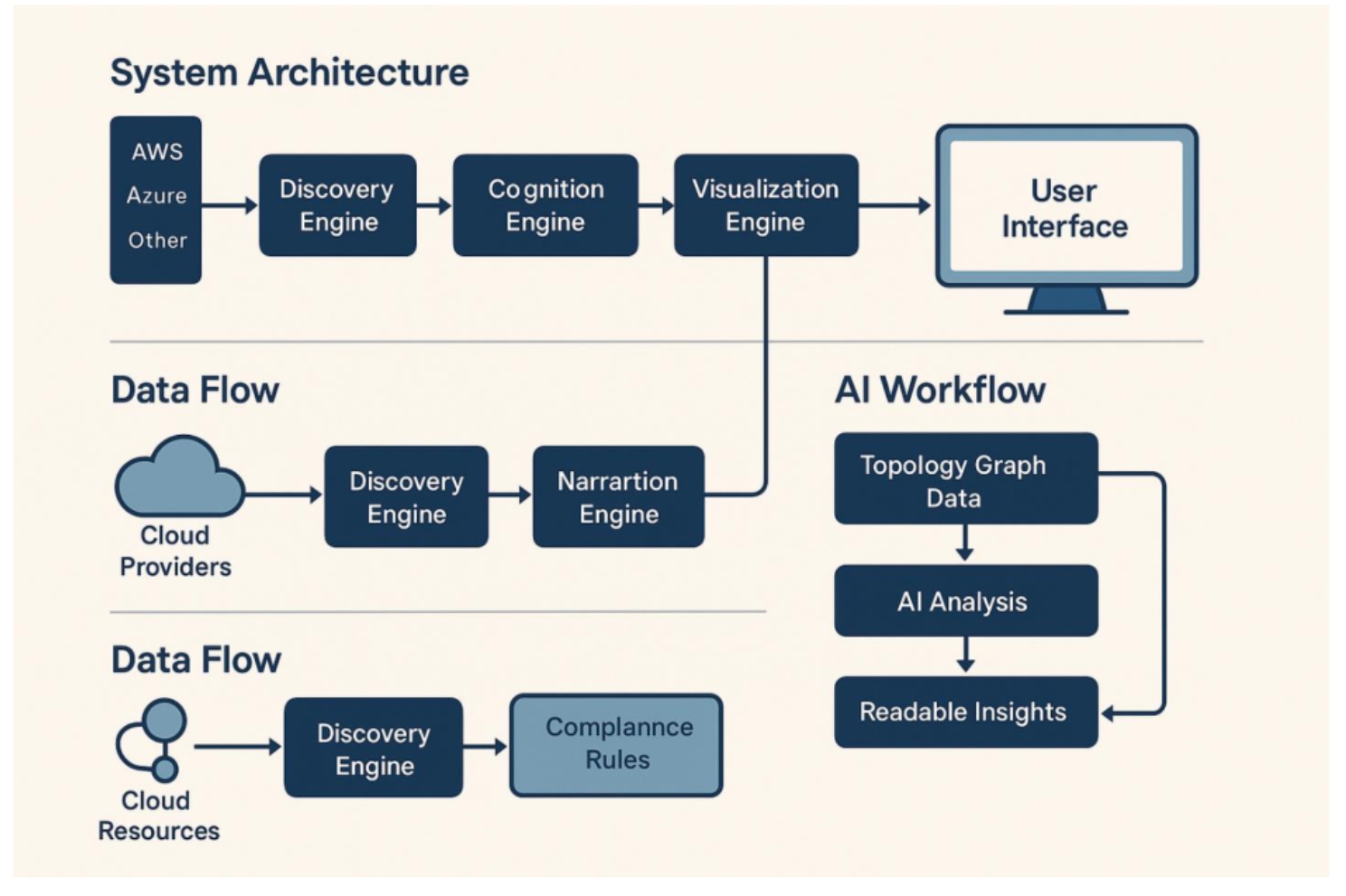
Evolution from the original system view to the governance-aware topology model.
Original Architecture
Governance-Aware Architecture (v2)
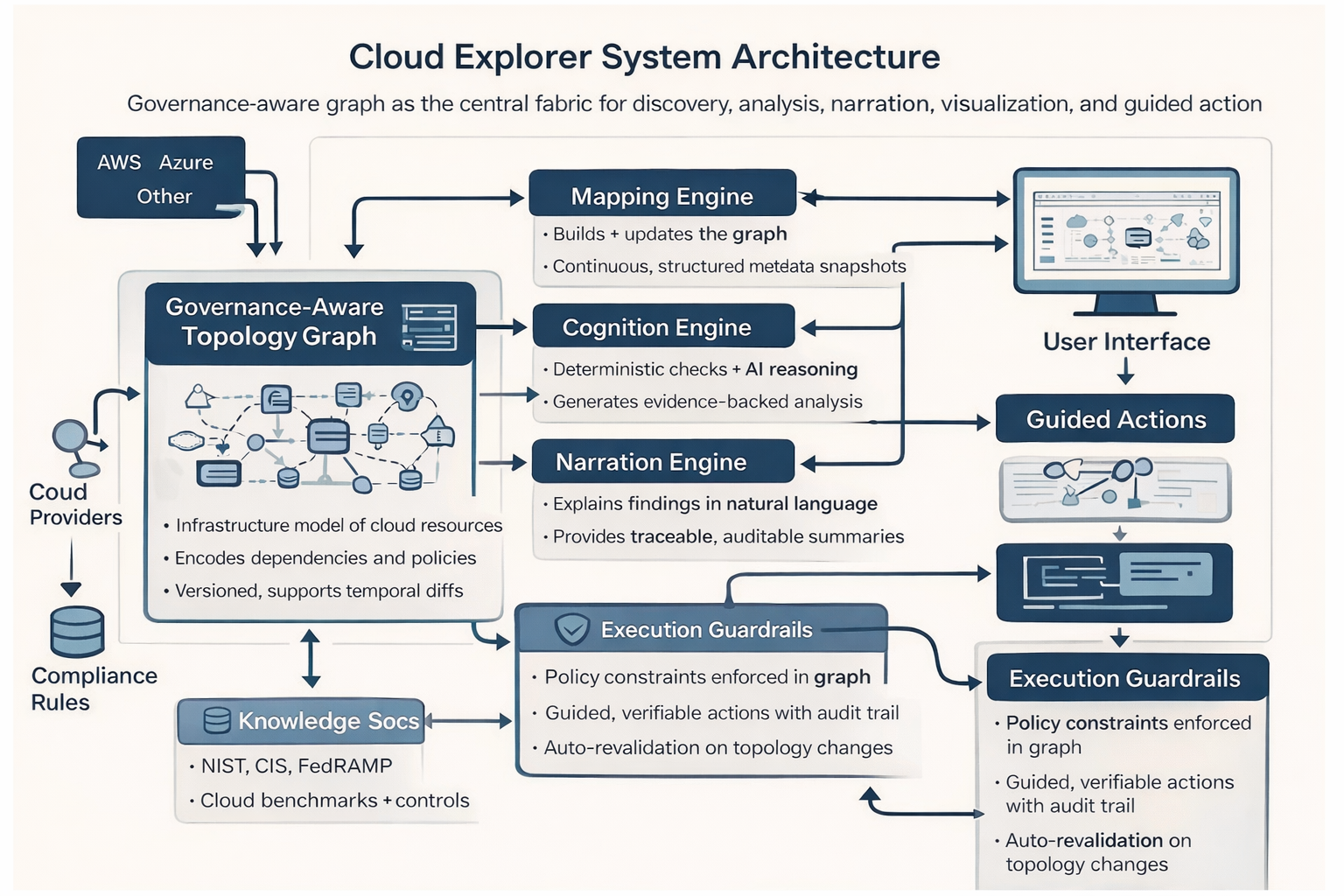
The updated architecture introduces a governance-aware topology graph as the authoritative system fabric, enabling explainable analysis and policy-bound execution.
The Problem
Modern cloud environments fragment across providers, accounts, identities, regions, and policies. Most tools answer isolated questions (inventory, cost, security) but struggle to explain relationships — and that’s where operational risk hides.
Cloud Explorer is designed to answer:
“What do we have, how is it connected, what does it mean — and what can we safely do next?”
Design Principles
Security First
Access is least-privilege and scoped; outputs and actions are designed to be auditable and explainable.
Relationships Matter
Model infrastructure as a graph so dependencies, trust paths, and blast radius are queryable.
AI With Guardrails
AI supports interpretation and summarization; execution stays policy-bound and deterministic.
Core System Model
Five major engines form the platform’s backbone: discovery → mapping → cognition → narration → visualization.
Discovery Engine
- Connects to provider APIs using scoped, time-bounded access
- Enumerates resources, identity, and policy metadata into structured snapshots
- Feeds the mapping layer continuously
Mapping Engine
- Synthesizes resources into a topology graph (compute, network, storage, identity)
- Encodes governance semantics (permissions, tags, dependencies)
- Becomes the central fabric for queries and visualization
Cognition Engine
- Hybrid reasoning: deterministic checks + AI assistance
- Supports compliance-aware interpretation using knowledge sources (e.g., NIST/CIS/FedRAMP)
- Generates evidence-backed findings and recommendations
Narration Engine
- Converts findings into human-readable summaries (exec + technical)
- Supports dialogue-style exploration (“why does X violate policy?”)
- Designed for traceable reporting
Visualization Engine
- Interactive exploration of the topology graph
- Overlays for risk, performance, and compliance context
- Narration is linked directly to the visual map for explainability
What it enables
- Real-time infrastructure understanding via a unified topology graph
- Compliance-aware snapshots and change awareness over time
- Graph queries like: “show internet-facing resources linked to non-compliant identities”
- Executive summaries and technical narratives that stay tied to evidence
Guided Execution
Cloud Explorer bridges visibility and action by supporting guided workflows that are policy-aware, traceable, and designed to reduce operational risk.
Role
Principal Architect & Lead Engineer — Christopher Stacks